


Master the Art of Lead Nurturing
What is Lead Nurturing?

Lead nurturing is the process of building relationships with potential customers, and trust is imperative to it.
Lead nurturing helps you keep your brand top-of-mind for your prospective customers while continuously nudging them through the buyer’s journey. Building the relationship increases trust and boosts the chances of closing and repeating sales. That also means existing customers are more likely to remember your business post-sale.
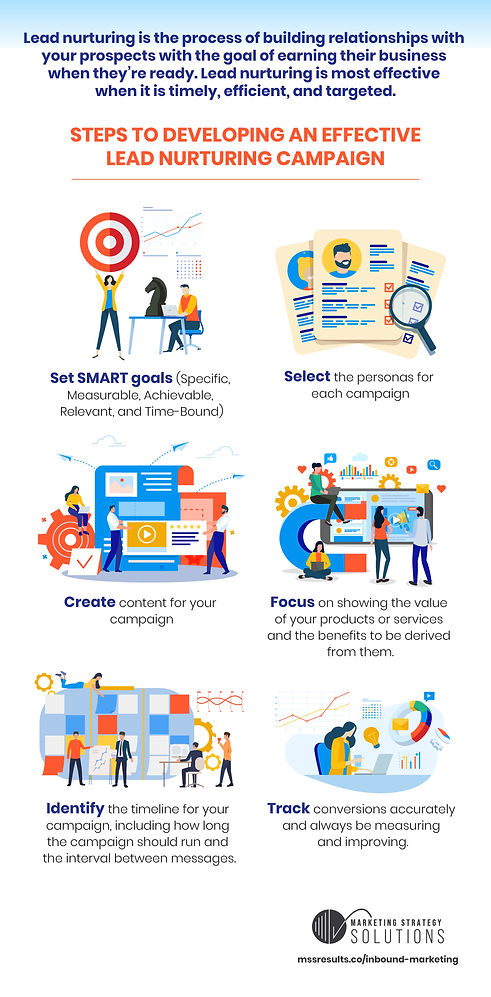
6 Steps to an Effective Lead Nurturing Campaign
-
Set SMART goals: Specific, Measurable, Achievable, Relevant, and Time-bound. Keeping your objectives SMART gives you a clear goalpost to work toward.
-
Select the personas for each campaign: This tailoring increases the likelihood of successfully engaging target leads with your brand.
-
Create content for your campaign: Quality content is an investment in your brand's success and can make all the difference in winning customers and growing your business.
-
Focus on demonstrating value and showcasing benefits: Inbound marketing is based on providing value because that is how you connect with the people truly interested in your product or service.
-
Establish the campaign timeline: Find the right campaign duration and messaging frequency based on previous campaigns, market research, and knowledge of your target audience.
-
Measure and Improve Constantly: Track conversions accurately and always be measuring and improving.
Ready to take your lead nurturing to the next level? With our step-by-step guide, you’ll be able to implement a targeted and efficient lead nurture strategy that will drive results for your business. Don't miss out on this valuable resource — download it now!
Step-by-Step Creating a Lead Nurturing Campaign
Step 1: Set SMART goals
SMART goals are an acronym, but it’s also smart to set them for any business effort. SMART stands for specific, measurable, achievable, relevant, and time-bound.
For example, a goal for a lead nurturing campaign could be to generate five new marketing qualified leads per week through social media outreach for the next three months.
-
Specific: This goal is narrowly focused on marketing qualified leads
-
Measurable: Quantifiable results (“5 new qualified leads per week")
-
Achievable: Based on previous data (for the sake of this example), we’ll say this is realistically attainable
-
Relevant: This goal ties directly to the business objective of attracting people through social media to generate leads that should move toward sales for increased revenue
-
Time-bound: Limited to the next three months (note: those should be tied to actual dates, so “the next 3 months” doesn’t slip into 4-5 months!)
Step 2: Select the personas for each campaign
Before launching any campaign, take the time to make a detailed, written description of your ideal customers including their challenges, and needs, and map out their likely journey from awareness to decision-making. This tailoring increases the likelihood of successfully engaging target leads with your brand.
Step 3: Create content for your campaign
Your content should be: professional, informative, and persuasive. It’s a difficult task, but it’s worth it to position your company as a thought leader in your industry. Quality content is an investment in your brand's success and can make all the difference in winning customers and growing your business. Need a guide to create content? Check out ours here.
Step 4: Emphasize demonstrating value and showcasing benefits
Consumers buy based on benefits, whether that’s function, prestige, or something else. This is why inbound marketing is based on providing value because that draws people in. Focus on highlighting the helpfulness of your products or services. Your goal is to connect with clients who are truly interested in the benefits your products or services offer.
Step 5: Establish the campaign timeline
By definition, campaigns run for a certain amount of time (though, they can, of course, be repeated). The campaign duration and messaging frequency depend on budgets and efficacy. No one wants to spend too much on their campaigns, but just spending the minimum might not lead to enough messaging. It’s a bit of a balancing act.
Too little communication could result in missed opportunities, while too many messages too frequently, may overwhelm your audience and lead to disengagement. Try to find a happy medium based on previous campaigns, market research, and knowledge of your target audience.
Step 6: Measure and Improve Constantly
Track and measure your results. Consistently review these metrics and SMART goals to identify what is working, what needs improvement, or a different approach to get better results. This knowledge increases the likelihood of successfully engaging your target audience and achieving business growth.